

A bulk material transfer wear survey should answer a purchasing question before it produces a material shortlist: which surfaces need protection, against what duty, and on what evidence? Ordering an alumina ceramic lining for every exposed surface can leave the original flow problem unexplained. Ordering only the visibly damaged patch can overlook the conditions that moved the wear there.
This guide proposes a practical way to organize that decision. It covers conveyors, transfer chutes and connected handling routes at the survey and procurement stage, rather than prescribing a chute design or an installation procedure. The objective is a traceable scope: a map of candidate wear zones, their uncertainties, and the information needed to compare quotations. Sanxin New Materials' wear-resistant ceramic parts are a starting point for discussing available product families, not a substitute for reviewing the actual application.
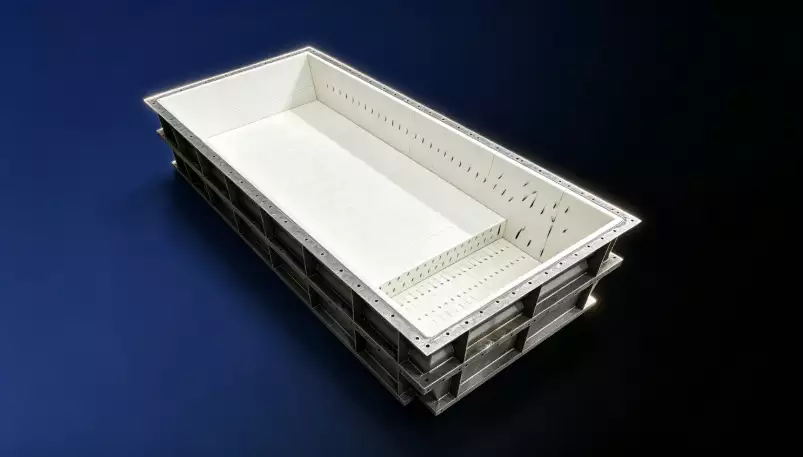
Start the survey brief with the operating problem, not a preferred ceramic grade. A useful statement identifies the equipment, the affected location and the consequence: repeated localized replacement, unacceptable material escape, an unresolved product cleanliness concern, or a wear-related restriction on the planned operating campaign. Keep suspected causes separate from these observations.
Then name the decision owner and the decision deadline. A buyer preparing a shutdown scope needs different evidence from an engineer comparing alternative transfer arrangements. Agree whether the current exercise will produce a preliminary budget, a request for technical proposals, or a purchase-ready specification. These are distinct deliverables.
Record what is outside scope. For example, the survey might identify a damaged support for separate assessment without approving its repair. It might flag a pressure boundary for the responsible engineering team without treating a wear liner as a structural repair. Boundaries prevent an attractive lining proposal from silently becoming approval of the entire equipment assembly.
Draw a simple route from the supplying process to the receiving equipment. Assign an identifier to each transfer, direction change, collection area and discharge. Use the identifiers consistently in photographs, drawings, maintenance records and supplier questions. A location described only as the lower left corner becomes ambiguous when a photograph is rotated or taken from the opposite side.
For each transfer, document the incoming and outgoing routes, the installed wear protection and the accessible reference dimensions. Distinguish dimensions measured during this survey from dimensions copied from an older drawing. Retain the drawing revision and record any mismatch; do not quietly redraw the equipment to match an assumption.
Add operating modes to the route map. A reversible conveyor, diverted stream or alternate feed can expose a different surface from the normal production route. Mark areas that have not been observed in that mode. An empty box labelled unknown is more useful than a confident-looking arrow that no operator or drawing can support.
The map should remain readable on one review sheet. Detailed photographs and measurements can sit behind it as linked evidence rather than crowding every note onto the outline.
The purchasing description should go beyond a commodity name. Ask the process team what the transfer actually handles across its scheduled duties, then identify the records or samples supporting the answer. A label such as mineral feed does not explain the range of particle sizes, changing moisture or occasional oversize events relevant to a proposal.
Request the available particle size distribution, bulk density, moisture information, material composition, temperature records and throughput history. Preserve the units and the basis of each measurement. State whether a figure is measured, estimated or specified by another party. If abrasiveness or flowability testing is available, attach the report instead of replacing it with an informal adjective.
List known feed changes, startup and shutdown conditions, upstream screen problems, foreign-object events and unusually wet material. Describe documented events without inventing their frequency. Ask the equipment owner which conditions a proposed system must accommodate and which require separate operating controls.
Where different materials share the route, keep separate duty descriptions until the responsible team agrees that combining them is valid. The objective is not to create an impossible worst case by merging unrelated maximum values. It is to show suppliers the real combinations they must evaluate, and to expose combinations for which the site has no evidence.
Plan access with the site's responsible personnel. Follow the approved isolation, access and inspection arrangements for the equipment and its contents. A procurement survey does not authorize entry, guard removal, access to moving equipment or changes to an operating process. Where a surface cannot be inspected safely, record that limitation and use an approved alternative or a later planned inspection.
Give every observation a date, location identifier and operating context. A photograph after cleaning may show the liner surface clearly, while an earlier photograph may explain where material accumulated. Preserve that distinction rather than treating the images as simultaneous evidence.
For dimensional results, identify the instrument, reference location and measurement method. State whether the result concerns the liner, its backing or the equipment shell. If the layer cannot be distinguished, do not label the reading as remaining ceramic thickness. Ask for an appropriate assessment before using it to set a replacement scope.
The survey should describe what is visible before naming a wear mechanism. Surface appearance alone may support several explanations. The following table is a proposed recording aid, not a diagnostic standard or permission to keep damaged equipment operating.
| Recorded observation | Question for the review | Useful next evidence |
|---|---|---|
| A narrow recurring band of material loss | Does the actual material path concentrate contact here? | Location-matched drawings, permitted operating observations and earlier photographs |
| Localized broken pieces or an exposed backing | Is the concern impact, assembly condition, handling damage, or a combination? | Retained fragments where safely available, event history and an assembly review |
| Material buildup beside a damaged region | Did the buildup precede the damage or develop afterward? | Dated observations from both conditions and the corresponding material duty |
| A sudden change near a joint or transition | Is the boundary influencing contact, or does it mark a different construction? | Joint details, installation history and dimensional verification |
Assign a confidence level to the working explanation. Confirmed should mean that the review team can name the supporting evidence, not simply that several people agree. Where two explanations remain plausible, state what would distinguish them. This prevents the request for quotation from presenting a hypothesis as an established cause.
Some locations need a transfer assessment before a lining quotation can be meaningfully compared. Martin Engineering's Foundations chapter on engineered flow chutes treats material behavior, trajectory and contact with chute surfaces as connected design considerations. This supports reviewing the transfer as a system; it does not establish that a specific ceramic will correct a particular site problem.
As an original survey recommendation, mark unresolved trajectory questions separately from material-selection questions. If the site cannot explain why contact has shifted from one wall to another, request a process or equipment review rather than assuming the new wall simply needs thicker protection.
Similarly, document any proposed change to the transfer geometry as a separate option. Give it an owner, an approval path and a clear relationship to the lining proposal. A supplier's material quotation should not be interpreted as approval of unverified modifications to clearances, supports, discharge alignment or the operating route.
An alumina ceramic grade is only part of a wear protection proposal. The review also concerns the proposed component shape, backing, attachment concept and interface with the existing equipment. Treat those elements as a system whose suitability still needs confirmation for the stated duty.
Sanxin's catalogue identifies several ceramic wear lining options, including ceramic rubber assemblies, bolt weld liners and ceramic pipe products. These families can help organize a technical discussion. Their presence in a catalogue does not make them interchangeable, establish stock availability, or confirm suitability for every transfer point.
Ask each supplier to explain which parts of the survey support its proposed configuration and which missing facts could change the recommendation. A useful response distinguishes a sliding-contact concern from an impact concern and explains how the complete assembly will be assessed. It should also identify conditions outside the proposal rather than promising universal resistance.
Do not rank proposals using hardness alone. Request relevant application evidence and the assumptions behind the selection. Where the duty cannot yet be defined adequately, keep the shortlist provisional instead of turning an incomplete comparison into a purchase specification.
Assign every mapped area one of four proposed dispositions: assess urgently under the site's existing procedures, develop a lining proposal, investigate further, or exclude from the present purchase scope. This makes the survey actionable without pretending that every surface is equally understood.
A small location may deserve early attention because of its documented consequence or limited access. A large surface may belong in a later phase because its duty remains uncertain. Record the reason for the priority alongside the evidence, so that a purchasing schedule does not become an unexplained list of expensive panels.
An inaccessible region should not receive a low priority merely because no wear was observed there. Give it an inspection action, an owner and a due point. Conversely, an area excluded from the current lining order should retain its identified maintenance or engineering actions.
Keep the disposition separate from the technical acceptance of a product. Develop a proposal means the zone is ready for supplier review, not that a selected material, thickness or attachment has already been approved. That distinction preserves room for a better option when the remaining evidence arrives.
Before asking for price, list constraints that affect whether a proposal can proceed. These may include the allowed installed envelope, access for component handling, cleanability, downstream restrictions on foreign material, and the approved operating conditions of the equipment. Identify which requirements are mandatory and which remain preferences.
Ask the supplier to address the whole assembly's environmental limits. Do not substitute the ceramic material's melting point for a permitted operating temperature of an adhesive, rubber layer, seal or complete installed system. Where supplier documents conflict, request a written clarification tied to the exact proposed construction.
Record interfaces with other project teams. Structural suitability, pressure containment, electrical considerations, fire precautions and product hygiene may need separate reviews according to the application. The survey can identify these dependencies without claiming to resolve them. A proposal should show which approval is still required and who supplies the necessary information.
Finally, distinguish a preferred shutdown window from a confirmed delivery commitment. A quotation comparison should not convert an unverified schedule assumption into a promise that the plant can rely on.
Request enough information to understand what a cited test actually examined. Identify the specimen, test method, test conditions, reported measure and comparison material. A result without those details may be interesting, but it cannot carry the same weight as a traceable report.
The public overview of ASTM G65 describes a dry sand and rubber wheel method for ranking metallic materials under specified scratching-abrasion conditions. Its stated scope matters: it is not a universal certificate for an entire ceramic lining assembly. Ask the laboratory to explain the applicability and any departure from the method when a report is used for a different material or configuration.
ASTM G76 addresses erosion by solid particles carried in a gas jet. Its overview notes that service conditions vary and that a single laboratory test may not establish expected field performance. A cited ranking therefore needs an explanation of its relationship to the surveyed duty.
These summaries are not test instructions. Agree the relevant evaluation with a qualified laboratory and the responsible technical team. Keep material-level comparisons separate from evidence about a supplied assembly, and do not convert a laboratory ratio directly into promised operating years.
A useful request for quotation gives suppliers a common factual starting point while leaving room for justified alternatives. Attach the route map and issue a numbered zone schedule. Each candidate zone should carry its duty description, known dimensions, observed condition, constraints and unresolved questions.
When requesting alumina ceramic wear-resistant parts, ask the supplier to state the proposed product family, drawing basis, supply boundary and required inputs. The response should identify whether pricing includes backing components, special shapes, attachment provisions, inspection documentation and any other project-specific items. Avoid assuming these are included because a photograph shows a complete assembly.
Include a deviations section. Suppliers should be able to say that a dimension needs confirmation, that a duty lies outside their recommendation, or that an alternative construction requires review. Make those responses visible in the comparison rather than burying them in correspondence.
Request a concise technical rationale for each different configuration. If the same solution is offered across every zone, ask what evidence supports that common selection. If many different configurations are offered, ask whether the differences are technically necessary or merely commercial options.
Normalize the quoted scope before comparing totals. Check that the proposals cover the same zones, quantities, supplied layers and documentation. Separate optional engineering, transport, site work and excluded components. A lower total may describe a smaller deliverable rather than a more economical solution.
Maintain two parallel records: technical questions and commercial questions. A competitive price cannot close an unresolved suitability issue. Equally, a technically credible proposal may still need quantity, delivery or warranty clarification before it becomes an acceptable order.
Where a supplier offers an improvement claim, request its basis and the conditions attached to it. Keep independently verified site results, supplier examples and forecasts in distinct categories. Do not relabel another company's operating history as a Sanxin project, and do not treat a forecast as an achieved saving.
The comparison meeting should finish with explicit dispositions: acceptable for the next review, clarification required, or unsuitable for the stated scope. Record who made each decision and which revision was reviewed.
Consider an illustrative transfer with three documented locations: an upstream contact plate, a sidewall band and a downstream discharge transition. This is a decision example, not a customer case or a prediction of liner performance.
The contact plate has a history of localized broken components, but the available records do not distinguish impact events from assembly problems. Its disposition is investigate further, with the technical team defining the required evidence. The purchasing team does not automatically specify the hardest ceramic available.
The sidewall band has repeated location-matched observations and an adequately described routine duty. It proceeds to a lining proposal, subject to confirmation of dimensions and interface requirements. Suppliers receive the same evidence and are asked to justify their configurations.
The discharge transition has limited access and incomplete condition records. It remains an explicit inspection dependency, not an assumed undamaged area. The resulting purchase scope can advance the understood zone while keeping the other decisions visible and controlled. The value is clearer responsibility, not a claimed reduction in wear before any product is installed.
Accessibility alone is not a selection criterion. Include a surface because the agreed scope and evidence justify assessing protection there. Record the treatment of adjacent areas so that exclusion is a conscious decision, not an omission from the drawing.
Ask whether the sample represents each relevant operating mode. Retain its collection context and any known limitations. If the route handles distinct feeds or conditions, the technical reviewer should decide whether additional characterization is needed before using one sample to support all proposals.
Issue a bounded investigation request instead of a purchase-ready lining specification. Name the competing explanations, the evidence that is missing and the decision that evidence will support. This can still move procurement forward by defining a justified next step without committing the site to an untested explanation.
Issue the survey as a dated revision with a short decision summary. Include the route map, zone schedule, evidence index, supplier questions and outstanding actions. Preserve the original observations so that a later reviewer can distinguish new information from a changed interpretation.
Before releasing an order, confirm that the approved proposal still matches the material duty and equipment configuration. If the feed, route or scope has changed, ask the responsible reviewers which decisions need reopening. Do not assume that an earlier material recommendation automatically transfers to the revised conditions.
Agree what information the next project stage must return to the record: approved drawings, supplied component identification, relevant inspection documents and resolved deviations. This article does not prescribe installation or operating acceptance criteria; those belong to the responsible project team and the approved scope.
For an initial discussion with Sanxin New Materials, share the mapped zones and evidence gaps alongside your drawings. Reviewing ceramic wear-resistant components for bulk material handling against that structured brief gives the supplier a more useful question than simply asking which ceramic lasts longest. The immediate outcome should be a justified next decision, with unknowns still visible.

Submit your demand,
we will contact you ASAP.

Sanxin New Materials Co., Ltd. focus on producing and selling ceramic beads and parts such as grinding media, blasting beads, bearing ball, structure part, ceramic wear-resistant liners, Nanoparticles Nano Powder


 English
 English
 Russian
 French
 Spanish
 Portuguese
 Arabic