


 English
 English
 Russian
 French
 Spanish
 Portuguese
 Arabic
Ball Mill vs. Rod Mill: Understanding the Differences and Choosing the Right Grinding Media
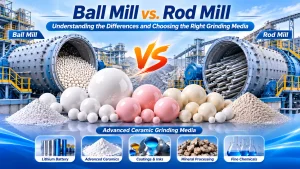
Ball Mill vs. Rod Mill: Understanding the Differences and Choosing the Right Grinding Media
1. Introduction: Why Mill Selection Matters in Mineral Processing
In modern mineral processing, grinding is one of the most energy-intensive stages of production. Whether processing copper, gold, iron ore, lithium-bearing minerals, quartz, or other industrial minerals, the grinding circuit directly influences particle size distribution, mineral liberation, downstream recovery, and overall operating costs.
Among the most widely used machines in conventional grinding circuits are ball mills and rod mills. Although both machines operate on the principle of rotating cylindrical drums, they differ significantly in grinding media, particle reduction mechanisms, product characteristics, and industrial applications.
A rod mill primarily uses long steel rods to achieve controlled coarse grinding, while a ball mill uses spherical grinding media to achieve a broader range of particle sizes, particularly in secondary and fine grinding.
Understanding the difference between a ball mill and a rod mill is essential when designing a new mineral processing plant, upgrading an existing grinding circuit, or optimizing grinding efficiency.
Beyond equipment selection, the choice of grinding media inside a ball mill is equally important. Steel grinding balls, alumina ceramic balls, and zirconia-alumina composite grinding media can deliver different results depending on ore characteristics, grinding conditions, and production targets.
This guide explains how ball mills and rod mills work, compares their main performance characteristics, and explores how appropriate grinding media selection can improve industrial grinding operations.
2. What Is a Ball Mill?
A ball mill is a tumbling grinding machine that uses spherical grinding media to reduce materials through impact, attrition, and abrasion.
Its main components include a rotating cylindrical shell, feed and discharge arrangements, internal liners, and grinding media.
How Does a Ball Mill Work?
During operation, the cylindrical shell rotates around its horizontal axis. As the mill rotates, the grinding balls are lifted along the internal liner surface before falling or cascading through the grinding chamber.
This movement generates two principal grinding actions:
Impact grinding: Falling or cataracting balls collide with larger particles, breaking them into smaller fragments.
Attrition grinding: Grinding media move against one another and against the material, gradually reducing particle size through friction and abrasion.
The combination of impact and attrition makes ball mills suitable for a wide range of grinding requirements, from secondary ore grinding to fine grinding and concentrate regrinding.
The final grinding performance depends on several operating parameters, including:
Grinding media diameter and size distribution
Media density, hardness, and wear resistance
Mill rotational speed
Media filling ratio
Feed particle size and material hardness
Slurry concentration and operating conditions
Liner profile and internal mill design
Main Applications of Ball Mills
Ball mills are widely used in:
Mineral processing: Grinding copper, gold, iron ore, lead-zinc ore, and other minerals before flotation or further separation.
Cement production: Grinding clinker, gypsum, and other cement raw materials.
Ceramic manufacturing: Processing ceramic raw materials, glaze, and mineral powders.
Chemical processing: Fine grinding and homogenizing various industrial powders.
Battery materials: Grinding and processing selected cathode, anode, and other functional materials, depending on the milling system.
Non-metallic minerals: Processing quartz, feldspar, kaolin, limestone, and other industrial minerals.
Ball mills are especially useful when a relatively fine and controlled product is required.
3. What Is a Rod Mill?
A rod mill is a cylindrical grinding machine that uses long steel rods instead of spherical grinding balls.
Its operating principle is similar to that of a ball mill, but the geometry of its grinding media creates a different grinding environment.
How Does a Rod Mill Work?
Inside a rod mill, long steel rods are arranged approximately parallel to the mill axis.
As the drum rotates, the rods tumble and interact with the material. Their cylindrical surfaces create predominantly line-contact grinding zones, concentrating the grinding action on particles caught between adjacent rods.
This selective grinding mechanism helps reduce coarse particles while limiting the unnecessary production of extremely fine particles, often called slimes.
Compared with conventional ball milling, rod milling can produce a more uniform, relatively coarse product in suitable applications.
Main Applications of Rod Mills
Rod mills are commonly applied in:
Primary grinding: Reducing crushed ore before secondary grinding.
Feed preparation: Producing a relatively uniform particle size for subsequent ball milling.
Gravity separation: Preparing mineral feed where excessive fines may negatively affect separation.
Magnetic separation: Controlling particle size and limiting unwanted ultrafine material in suitable circuits.
Sand and aggregate production: Processing selected materials where particle size distribution and product shape are important.
Industrial materials: Grinding certain limestone, slag, coal, and other materials.
Rod mills are particularly useful when controlled coarse grinding and reduced overgrinding are important process objectives.
4. Ball Mill vs. Rod Mill: Key Differences
Although ball mills and rod mills share a similar rotating-drum structure, their operating characteristics are different.
The following table summarizes the major distinctions.
| Comparison | Ball Mill | Rod Mill |
|---|---|---|
| Grinding media | Steel or suitable ceramic balls | Long steel rods |
| Contact mechanism | Mainly point contacts | Predominantly line contacts |
| Grinding action | Impact and attrition | Selective crushing and abrasion |
| Typical duty | Secondary and fine grinding | Primary and coarse grinding |
| Product size | Generally finer | Generally coarser |
| Particle distribution | Can be relatively broad | Often more uniform in suitable conditions |
| Overgrinding | Requires careful control | Often less prone to overgrinding |
| Media management | Ball size distribution and charge | Rod length, diameter, charge and alignment |
| Common applications | Mineral liberation, regrinding, fine powder production | Coarse grinding and feed preparation |
4.1 Difference in Grinding Media
The most fundamental distinction is the grinding media.
Ball mills use spherical media, which generate multiple impact and abrasion points throughout the grinding chamber.
Rod mills use elongated steel rods, which create more concentrated grinding zones along their length.
The shape of the media determines how energy is transferred to the material and influences the resulting particle size distribution.
4.2 Difference in Grinding Efficiency
Neither machine is universally more efficient.
A rod mill can perform effectively when the objective is to reduce coarse feed while minimizing excessive fines.
A ball mill is generally more suitable when further particle size reduction and mineral liberation are required.
The actual grinding efficiency depends on the material’s grindability, feed size, target fineness, operating conditions, and grinding circuit configuration.
4.3 Difference in Product Particle Size
Rod mills generally produce a relatively coarse product with fewer ultrafine particles under suitable operating conditions.
Ball mills can generate much finer products through repeated impact and attrition.
For mineral processing plants, this distinction is particularly important because excessive fines may negatively affect certain separation processes, while insufficient grinding can leave valuable minerals locked inside gangue particles.
The ideal particle size is therefore determined by the downstream process rather than by grinding equipment alone.
4.4 Difference in Grinding Circuit Position
Rod mills are traditionally used as primary grinding equipment, often preparing material for subsequent ball milling.
Ball mills commonly operate in secondary grinding, tertiary grinding, and concentrate regrinding circuits.
However, modern mineral processing plants use various configurations, including SAG mills, ball mills, vertical mills, and stirred mills. Not every plant requires both a rod mill and a ball mill.
5. Ball Mill or Rod Mill: Which One Should You Choose?
Choosing between a ball mill and a rod mill requires an understanding of the entire production process, rather than simply comparing equipment specifications.
Several important factors should be considered.
5.1 Feed Particle Size
If the feed material contains relatively coarse particles and the objective is controlled initial size reduction, a rod mill may be appropriate.
For finer feed requiring additional particle reduction, a ball mill is generally a more suitable option.
5.2 Required Final Particle Size
The required product fineness is one of the most important selection criteria.
If the target is a relatively coarse and uniform product, rod milling may provide advantages.
If the process requires finer grinding to improve mineral liberation, a ball mill is typically preferred.
For ultra-fine grinding, specialized stirred mills or bead mills may provide better process efficiency than conventional tumbling mills.
5.3 Mineral Characteristics
Different minerals respond differently to grinding.
For example:
Copper and gold ores may require fine grinding to liberate valuable mineral particles.
Quartz and feldspar processing may require precise particle size control.
Lithium-bearing ores may require carefully controlled grinding to preserve the desired mineral characteristics.
Certain iron ore and industrial mineral processes need to minimize unwanted fine particles.
Laboratory grinding tests and pilot-scale evaluation are recommended before final equipment selection.
5.4 Downstream Separation Requirements
Grinding performance should always be evaluated in relation to the next processing stage.
For example, flotation performance is influenced by liberation, particle size, surface characteristics, and reagent conditions.
Excessive grinding may increase the amount of ultrafine material, while insufficient grinding may leave valuable minerals inadequately liberated.
A properly designed grinding circuit should balance particle size reduction, energy consumption, and downstream recovery.
5.5 Operating Costs and Energy Consumption
The initial purchase price of a grinding mill is only one part of its total operating cost.
Plant operators should also evaluate:
Electricity consumption
Grinding media consumption
Liner wear and replacement
Maintenance and downtime
Grinding circuit throughput
Product quality and recovery
A grinding system that delivers a lower cost per tonne of acceptable product may be more economical even when its initial investment is higher.
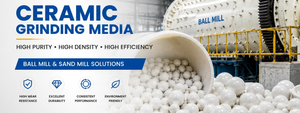
Ceramic Grinding Media for Ball Mill & Sand Mill
6. Grinding Media Selection: An Important Factor in Ball Mill Performance
Selecting the right mill is only part of the equation. The grinding media inside the mill can significantly influence grinding efficiency, product quality, media consumption, and operating costs.
Traditional ball mills commonly use steel grinding balls. However, ceramic grinding media are increasingly considered for applications where iron contamination, wear consumption, and energy efficiency are important concerns.
The most suitable media depends on the mill design, operating intensity, particle size target, and characteristics of the material being processed.
6.1 Steel Grinding Balls
Steel grinding balls are widely used in conventional ball mills, particularly in coarse and high-impact mineral grinding applications.
Advantages:
High impact resistance
Suitable for heavy-duty grinding conditions
Available in a wide range of diameters
Established industrial application experience
Limitations:
Wear can introduce iron contamination into the ground material.
Corrosion and abrasion may increase media consumption.
Frequent media replenishment can increase maintenance and operating costs.
Steel balls remain an important option for demanding grinding conditions, but alternative media may be worth evaluating when product purity and wear performance become critical.
6.2 Alumina Ceramic Grinding Balls
Alumina ceramic grinding balls offer an alternative to steel media in suitable medium- and fine-grinding applications.
Their main characteristics include high hardness, chemical stability, low iron contamination, and good wear resistance.
Different alumina grades can be selected according to the grinding intensity and production requirements.
For mineral processing applications, high-alumina ceramic media are particularly relevant to secondary grinding and regrinding circuits where reduced metallic contamination is desirable.
SANXIN offers several alumina grinding media grades for different grinding requirements, including TA-series mineral grinding balls.
6.3 ZTA Ceramic Grinding Balls
ZTA stands for zirconia-toughened alumina.
This composite ceramic material combines the hardness of alumina with improved toughness associated with zirconia reinforcement.
ZTA grinding balls are designed for applications requiring a balance of density, hardness, mechanical strength, and wear resistance.
Depending on the formulation and operating conditions, they can be considered for:
Copper and gold ore grinding
Non-ferrous mineral processing
Fine grinding and regrinding
High-density slurry applications
Selected vertical and stirred mill operations
SANXIN’s mineral grinding media range includes TZ37, TZ45, TZ47, and other ZTA ceramic ball grades developed for different grinding requirements.
For example, SANXIN TZ47 ZTA ceramic balls feature a published density of at least 4.65 g/cm³ and a reported wear rate of no more than 0.03 g/kg·h.
Product selection should always consider the required media size, mill type, and actual operating conditions.
Learn more: SANXIN TZ47 ZTA Ceramic Grinding Balls.
6.4 PMB Pink Mine Ball – Advanced Ceramic Grinding Media for Mineral Processing
For large-scale mineral processing operations, selecting grinding media with high impact resistance, excellent wear performance, and stable grinding characteristics is essential.
SANXIN’s PMB Pink Mine Ball is a high-performance composite ceramic grinding ball developed for demanding mineral grinding applications.
Its composite formulation combines alumina and zirconia, with the main published technical composition:
Al₂O₃ + ZrO₂ ≥91.0%
Cr₂O₃ + MnO₂ ≥3.0%
Key Technical Specifications of PMB Pink Mine Ball
| Testing Item | Technical Specification |
|---|---|
| Main Composition | Al₂O₃ + ZrO₂ ≥91.0% |
| Additional Components | Cr₂O₃ + MnO₂ ≥3.0% |
| Density | ≥3.90 g/cm³ |
| Vickers Hardness | 1450 HV10 |
| Crushing Strength (Φ50 mm) | ≥350 kN |
| Equivalent Wear Rate (Φ40 mm) | 0.01% |
Main Performance Advantages
1. High Impact Resistance
PMB is developed for demanding industrial grinding conditions where grinding media must withstand repeated impacts and high mechanical loads.
Its high published compressive strength helps reduce the risk of media breakage and associated production interruptions.
2. Ultra-Low Wear
With a published equivalent wear rate of 0.01% for a Φ40 mm ball, PMB is designed to reduce grinding media consumption and extend operating life.
3. High Grinding Efficiency
Its density of at least 3.90 g/cm³ provides a balance of grinding energy and mechanical performance for suitable mineral grinding applications.
4. Reduced Contamination
The composite ceramic formulation is intended for high-purity grinding applications where minimizing unwanted metallic contamination is important.
5. Stable Industrial Operation
High mechanical strength, wear resistance, and chemical stability make PMB suitable for demanding grinding environments.
PMB Applications in Mineral Processing
PMB Pink Mine Ball is designed for primary and secondary grinding applications involving:
Gold ore
Copper ore
Rare earth ores
Quartz and feldspar
Kaolin and other non-metallic minerals
Coal and selected industrial materials
It is intended for use in demanding industrial grinding operations, including large-scale ball milling applications.
For mining companies seeking alternatives to conventional steel grinding media, PMB provides another option to evaluate based on ore properties, mill operating conditions, and total grinding costs.
Explore the product: SANXIN PMB Pink Mine Ball – Mineral Processing Grinding Media.
7. Can Ceramic Grinding Balls Replace Steel Balls in Ball Mills?
The answer depends on the grinding application.
Ceramic grinding media can replace steel balls in selected ball milling and fine-grinding circuits, particularly when reducing iron contamination, media wear, or specific energy consumption is a priority.
However, a complete replacement is not always technically or economically appropriate.
Before switching from steel to ceramic media, processing plants should evaluate several factors.
1. Mill Operating Conditions
Rotational speed, impact intensity, liner configuration, mill dimensions, and media filling ratio all influence grinding performance.
2. Ore Characteristics
Hardness, abrasiveness, feed particle size, and mineral composition affect the suitability of different media materials.
3. Grinding Media Properties
Density, hardness, toughness, crushing strength, and wear rate must be considered together rather than independently.
4. Production Targets
Throughput, final particle size, mineral liberation, and recovery requirements determine whether a proposed media change is beneficial.
5. Economic Performance
Total grinding costs should include media consumption, electricity, maintenance, downtime, and the value of the resulting product.
In some applications, a gradual transition or mixed-media approach may be worth testing before a complete conversion.
A controlled industrial trial is the most reliable way to verify whether ceramic grinding media can deliver operational benefits under actual plant conditions.
8. How to Select the Right Grinding Media for Different Grinding Operations
Different grinding operations require different media characteristics.
The selection should be based on grinding intensity, equipment design, material hardness, required product fineness, and contamination limits.
| Grinding Application | Potential Media Choice | Main Consideration |
|---|---|---|
| Coarse mineral grinding | Steel grinding balls | Impact resistance and media size |
| Secondary mineral grinding | Steel or selected ceramic balls | Grinding efficiency and wear |
| Fine mineral regrinding | ZTA ceramic balls | Density, toughness, and wear |
| High-purity mineral grinding | PMB or suitable ceramic media | Contamination control and media durability |
| Industrial powder grinding | Alumina ceramic balls | Hardness and chemical stability |
| High-energy stirred milling | Specially engineered ceramic media | High-speed wear and mechanical strength |
The table provides general guidance rather than a universal selection standard. Actual media performance should be confirmed through laboratory testing, pilot trials, or industrial operating data.
The objective is to achieve an appropriate balance between particle size reduction, throughput, media consumption, and total operating cost.
9. Why Choose SANXIN for Ceramic Grinding Media?
SANXIN New Materials Co., Ltd. is an integrated manufacturer specializing in advanced ceramic materials, industrial grinding media, and wear-resistant ceramic products.
With experience in ceramic materials and grinding applications, SANXIN provides grinding media solutions for mineral processing, fine powder production, advanced ceramics, and other industrial applications.
Its product portfolio includes:
Alumina ceramic grinding balls
Zirconia grinding beads
Zirconia-toughened alumina (ZTA) grinding balls
Zirconium silicate grinding beads
Ceria-stabilized zirconia beads
Silicon carbide and silicon nitride ceramic media
Specialized mineral grinding media, including PMB and WMB
Different materials and product grades are available for different grinding intensities, equipment configurations, and production requirements.
Rather than recommending one grinding media material for every operation, SANXIN focuses on matching media characteristics with actual working conditions.
For mineral processing plants, the right media selection can help address important operational challenges, including excessive wear, iron contamination, high grinding costs, and unstable particle size distribution.
Explore SANXIN’s product range:
10. Frequently Asked Questions (FAQs)
Q1: What is the main difference between a ball mill and a rod mill?
The main difference is their grinding media and grinding mechanisms. Ball mills use spherical grinding balls to generate impact and attrition, while rod mills use long steel rods to produce predominantly line-contact grinding. Ball mills are generally used for finer grinding, whereas rod mills are commonly used for controlled coarse grinding.
Q2: Which is better for fine grinding, a ball mill or a rod mill?
A ball mill is generally more suitable for fine grinding because spherical media generate repeated impact and abrasion throughout the grinding chamber. For ultra-fine grinding, stirred mills and specialized bead mills may offer additional advantages.
Q3: Why does a rod mill produce fewer ultrafine particles?
The parallel arrangement of steel rods creates relatively selective grinding zones. Larger particles are preferentially reduced between the rods, which can limit excessive grinding of already-small particles.
Q4: Can a ball mill and a rod mill work together?
Yes. A rod mill can perform primary grinding and prepare a relatively uniform feed for a secondary ball mill. However, the actual configuration depends on ore characteristics, production capacity, and the required final particle size.
Q5: Which grinding media are suitable for ball mills?
Steel balls, alumina ceramic balls, and ZTA ceramic balls can all be used in suitable ball milling applications. The choice depends on impact conditions, media density, wear resistance, contamination requirements, and economic considerations.
Q6: What is PMB Pink Mine Ball?
PMB Pink Mine Ball is SANXIN’s composite ceramic grinding media developed for mineral processing and demanding industrial grinding applications. Its published composition includes Al₂O₃ + ZrO₂ ≥91.0% and Cr₂O₃ + MnO₂ ≥3.0%, with a density of at least 3.90 g/cm³ and Vickers hardness of 1450 HV10.
Q7: Can ceramic grinding balls reduce iron contamination?
Alumina and other suitable ceramic grinding media can help reduce metallic iron contamination compared with conventional steel grinding balls. The actual result depends on media wear, raw material composition, equipment condition, and operating parameters.
Q8: How do you choose the right ceramic grinding balls for a ball mill?
The main factors include ore hardness, feed particle size, target fineness, mill diameter, rotational speed, grinding media density, wear rate, and required production capacity. Industrial trials are recommended to verify performance before large-scale replacement.
Q9: Is PMB suitable for large-scale mineral processing?
PMB is developed for demanding mineral grinding operations, including primary and secondary grinding. Its high compressive strength, density, and low published wear rate make it a candidate for evaluation in suitable large-scale ball mill circuits.
11. Conclusion
Ball mills and rod mills play different but complementary roles in industrial grinding.
Rod mills are generally preferred for controlled coarse grinding and feed preparation, while ball mills are widely used for secondary grinding, mineral liberation, and finer particle size reduction.
However, selecting the correct grinding equipment is only one part of an efficient grinding process.
The grinding media inside the mill also affect energy consumption, wear rate, contamination, particle size distribution, and overall production costs.
As mineral processing plants continue to pursue higher grinding efficiency and improved product quality, advanced ceramic grinding media are becoming an important alternative for selected mineral grinding and regrinding applications.
Among these solutions, SANXIN PMB Pink Mine Ball offers a combination of high compressive strength, wear resistance, and stable grinding performance for demanding mineral processing applications.
SANXIN also provides alumina and ZTA ceramic grinding media to support different industrial grinding requirements.
Choosing the right material, media size, and grinding configuration can help improve process stability and optimize the total cost of operation.
Looking for a reliable ceramic grinding media solution for your mineral processing plant?
Contact SANXIN New Materials for professional grinding media selection and technical support.
Website: https://beadszirconia.com/
Email: sales@beadszirconia.com
WhatsApp: +86 19070858212